

What is a blockchain?

Blockchain technology is often described using complex technical terms by experts in fields like mathematics, cryptography and network systems. However, blockchains are simpler to grasp than they initially appear, at least in some aspects.
Therefore, in this guide, we'll begin with the elementary idea of a computer and gradually progress toward the concept of a blockchain. If you're already acquainted with concepts such as servers, databases and distributed networks, you might want to jump directly to the section about blockchains.
Fast Facts:
A blockchain is a type of database that is distributed, meaning it is not all stored in one location much like servers for a social media service would be, for example.
The data on blockchains is predominantly cryptocurrency transactions, though it technically store other data as well.
Instead of storing data in folders or tables like regular databases, blockchains group data (transactions) by chronological order in what are called blocks.
Anyone can access the Bitcoin blockchain, unlike databases owned by companies, governments or other institutions.
In blockchains, you can only add new data; you can't delete or change existing data like in more standard databases.
What is a computer?
Simply put, a computer is an electronic device designed to process and handle information. There are various types of computers, such as desktops, laptops, tablets, gaming systems and smartphones.
What is data?
Data is like the information or details about things around us. Imagine it like pieces of knowledge – like names, numbers, or facts – that are collected and used by computers or people to learn, make decisions, or do tasks. For example, the names and addresses in a phone book, scores in a game or the temperature each day are all examples of data.
In the past, this information was kept on things like paper or film. Nowadays, with the advancement of computers, we store this information in a digital form. And computers allow us to remove, move or alter data quickly and easily. Our personal data can be store either locally, meaning within the storage of our personal computer, or it can be stored on servers.
What is a server?
Servers are special types of computers that store websites, files, databases or provide other services. When you use a website or service, you're actually connecting to the server where it's stored. For instance, checking your Gmail means you're reaching out to a Google server that hosts Gmail.
Every computer has what's known as an IP address (internet protocol address), which is like a postal address for computers. The name of a website is really a shortcut to the server's IP address where the website lives. So, when you enter "Google" in your browser, it directs you to the server, or computer, that hosts Google.
To manage heavy traffic, servers can be arranged so several of them share the same IP address. This way, big websites like Google can distribute visitor requests across many servers.
What is a database?
The next step in understanding blockchain is to grasp what a database is.
Think of a database as a huge store of information kept on servers that can be quickly accessed, managed and updated.
This vast store of information, or “data,” may require hundreds or even thousands of servers. These servers are often housed in large facilities known as server farms, which are essentially big buildings filled with thousands of computers.
Big internet companies like Amazon and Google use these enormous server farms to store their websites, apps and the data of their users and systems. Generally, only select authorized people have control over these databases, and they are located in a single central place. The security of these databases relies heavily on the server farm not experiencing technical issues and on the cybersecurity of the authorized administrators.
If something like a fire happens at the server farm, data could be lost. Or if there's a security breach, data might be stolen or corrupted. Since these central locations and control points are easy targets for hackers, some databases are spread out over computers in different locations. These are known as distributed databases.
What is a distributed database?
Distributed databases are kept on servers that are located in different places, not just in one spot. This is mainly for safety reasons. In these systems, the servers are often referred to as nodes.
If one of these nodes has a problem or gets hacked, it can be turned off without affecting the rest. The other nodes, located elsewhere, keep working to ensure the database stays up and running.
With this understanding, grasping blockchain becomes easier. Essentially, a blockchain is a type of distributed database.
What is a blockchain?
A blockchain is a distributed database with some differences to more common databases and distributed databases. Its key differences lie in the kind of data it holds, how it's stored, who can access it and the fact that the data on a blockchain can't be changed or removed.
Note: There are two types of blockchains – "permissionless" (open to everyone like Bitcoin) and "permissioned" (restricted access, created by organizations). This explanation focuses on the permissionless type, like Bitcoin.
What it stores: The Bitcoin blockchain keeps a record of all Bitcoin transactions.
How it stores data: Unlike standard databases with arbitrary folders, Bitcoin records transactions in "blocks." New transactions are grouped into these blocks.
Once a block is full, it's linked to the previous one, forming a chain – that's why it's called a "blockchain." This method creates a time-ordered record of transactions, much like a ledger, from the very first transaction to the most recent one. The blockchain stores these blocks in a way that provides a complete, unalterable history of Bitcoin transactions.
Access: Bitcoin's blockchain, like any database, requires computers to operate. But unlike typical databases, it's not stored in one place. It's spread across numerous computers and locations, ensuring that if one computer fails, the others maintain the record of transactions.
Instead of being run by governments or companies, Bitcoin depends on individuals with personal computers. Anyone can become a part of the Bitcoin network by downloading its open-source software and the full or partial transaction history. Doing so would make your computer a node within the Bitcoin blockchain.
Immutability of transactions: A major distinction between typical databases and Bitcoin is that Bitcoin transactions cannot be changed or deleted. In this sense, Bitcoin's blockchain is like a write-only database, where once a transaction is recorded, it remains permanent and unalterable.
What makes Bitcoin special?
Also, how does this kind of database ensure its data is correct? And how does it stay safe when just about anyone can join in and run a node?
These are important questions, and it's here that Bitcoin starts to get really intriguing. While the basic idea of Bitcoin’s blockchain is straightforward, it includes some special features that mark a significant advance in the field of computer science.
There was this long-standing issue in computer science called the Byzantine Generals Problem, which wasn't fully solved until the creation of Bitcoin by Satoshi Nakamoto. Robert Shostak first identified and defined this problem in 1978 during a project sponsored by NASA.
The problem can be understood through a comparison made by researchers Leslie Lamport, Robert Shostak and Marshall Pease in their 1982 paper. They described it like this:
“We imagine that several divisions of the Byzantine army are camped outside an enemy city, each division commanded by its own general. The generals can communicate with one another only by messenger. After observing the enemy, they must decide upon a common plan of action. However, some of the generals may be traitors, trying to prevent the loyal generals from reaching agreement."
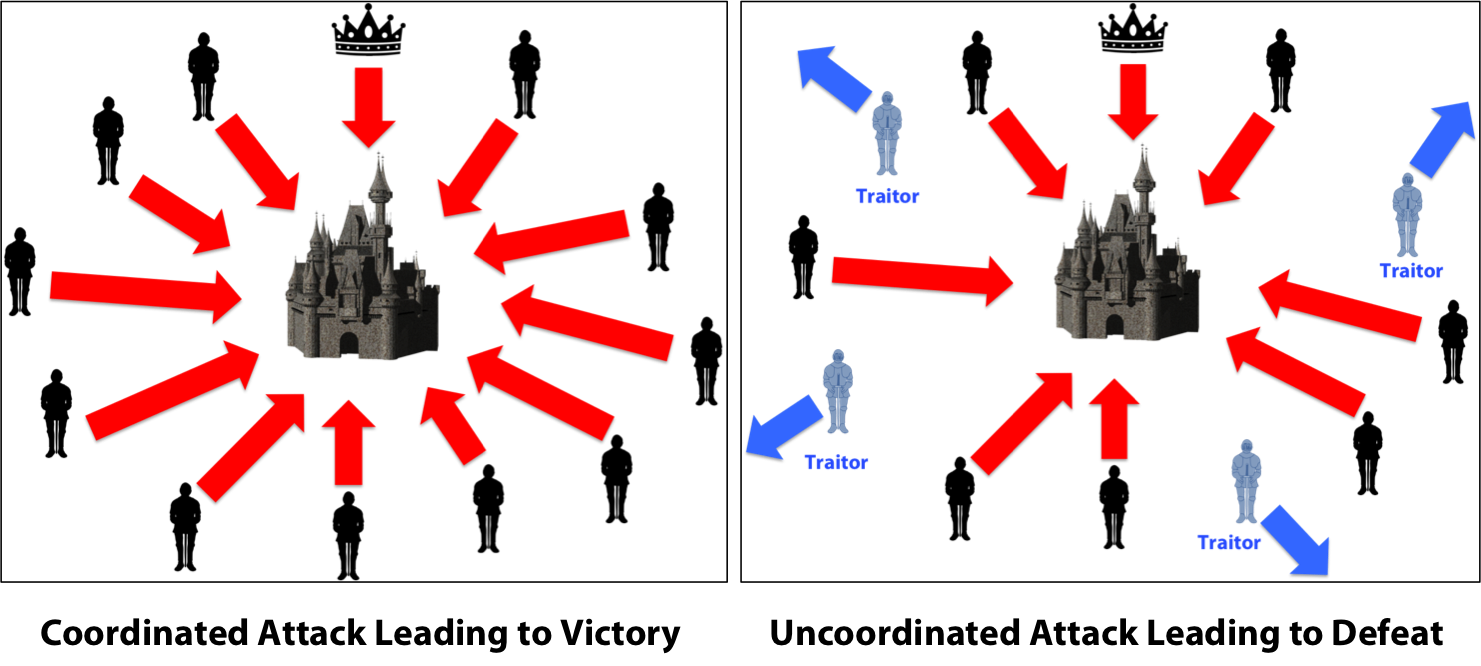
If all generals attach in unison, victory is secured. If some generals betray their side they will not take the city.
So, how do the generals make sure they all agree and that the information they're getting is right? If they don't work together, they could lose the battle.
Now, think of this in terms of a database, but instead of generals, there are nodes (computers). What if some of these nodes start giving out wrong information? How does the database decide which data is correct? For instance, imagine some computers say it's 12:30 p.m. while others say it's 12:30 a.m. How do they figure out which is right?
In a centralized database run by a company or government, there are people in charge who could fix this issue. But in a distributed database like a blockchain, where nodes are managed by various people over the internet who could be hundreds of miles away from each other, this isn't as straightforward.
To tackle this challenge, Satoshi Nakamoto implemented a system, also known as a consensus mechanism, known as proof-of-work.
What is a consensus mechanism?
A consensus mechanism is a way for computers in a distributed system (like databases or blockchains) to agree on the correct set of data. In simple terms, it's a set of rules helping everyone decide what's right.
This is key to the security of blockchain networks. It lets the participating computers, called nodes, confirm the truth of data (like transactions) without needing to trust each other.
Satoshi Nakamoto, the creator of Bitcoin, used a consensus method known as Proof-of-Work (PoW) to overcome the classic computer science problem. PoW is linked with the term "mining" in Bitcoin.
Proof-of-Work Explained
In basic terms, Proof-of-Work involves Bitcoin nodes competing to add a new set of transactions, or a block, to the blockchain. They do this by solving a very complex problem first.
The problem is tough to solve but easy for others to check once it's done. The node that solves it presents a "proof" that others can quickly verify.
Consider an analogy from Nathaniel Popper’s book, "Digital Gold":
“...it is relatively easy to multiply 2,903 and 3,571 using a piece of paper and pencil, but much, much harder to figure out what two numbers can be multiplied together to get 10,366,613.”
In this analogy, a node has to guess the right number pair that multiplies to a specific number. Once it finds it, it presents the solution, or proof, to others who can easily confirm it's right.
The first node to solve the puzzle gets to share the new transactions with all other nodes. This means only those who put in significant effort and computing power can add to the transaction ledger.
When nodes get a new block, they check it against past transactions to ensure everything adds up. If it does, the new block joins the chain, stored forever on the blockchain. The successful node is rewarded with Bitcoin for their efforts.
This process is called "mining" because it can be thought of as the digital equivalent of mining for gold – it requires a lot of computer work and energy to get the Bitcoin reward.
The high computational effort needed to add a block makes it nearly impossible to include fake transactions, like adding extra Bitcoin to a wallet. To attempt this, one would need over half of all Bitcoin computing power, a feat too costly and complex for anyone, even governments.
If successful, such a scheme would be noticed, causing people to sell their Bitcoin, devaluing the very currency being counterfeited and making the process fruitless.
Thus, Proof-of-Work solves the problem of trust because nodes can be sure new transactions aren't fake without needing to know each other. The Bitcoin reward provides an incentive to maintain, not attack, the system. As long as people value Bitcoin, its blockchain will stay secure.
The outcome is a permanent record of transactions, controlled collectively by its users rather than any single entity like a company or government.
